Insights
Deep Dive
Transition from Agency to Client-Side (Landlord)
Make the switch with confidence—learn how owners measure performance and build the skills in-house teams expect.
Published December 9, 2025 · 15 min read
Expand Your Career With SKILLINGS Education

Moving from agency to the client side calls for a different toolkit: portfolio thinking, budgeting, risk, tenant retention, and long-term planning.

SKILLINGS Education provides practical, Australia-aligned training, templates, and support so agency professionals can operate like owners—aligning leasing, upgrades, and risk to improve operating income and asset value. Whether you’re targeting asset management or in-house leasing, we’ll help you build a clear, practical path.

Who This Guide Is For:

The diagram shows how SKILLINGS Education can help you move from agency roles (Commercial Leasing, Property Management, Tenant Rep) into client-side pathways—In-House Leasing and Asset Management—with indicative Australian salary bands. Client-side roles typically offer base salary + bonus and a higher long-term pay ceiling.

Agency Commercial Leasing
$60,000 - $150,000 1
Agency Property Management
$55,000 - $135,000 1
Agency Tenant Representative
$90,000 - $125,000 2
In-House Leasing
$60,000 - $150,000 1
Asset Management
$60,000 - $250,000 1
1 Hays Salary Guide FY24/25, June 2024
2 Jora Tenant Representatives Salary Australia, August 2025
Residential Leasing
$50,000 - $68,000 1
Strata Management
$80,000 - $87,000 2
Body Corporate Management
$80,000 - $87,000 2
Residential Property Management (Leasing Focus)
$50,000 - $100,000 3
Commercial Leasing
$60,000 - $150,000 3
Commercial Property Management (Leasing Focus)
$55,000 - $135,000 3
Lease Administration
$50,000 - $110,000 3
Tenant Advisory
$90,000 - $135,000 4
Resimercial (Hybrid)
1
2
3
4
PayScale Leasing Consultant Data, December 2023 & Indeed Leasing Consultant, February 2025
Connect Skills Institute Salary Calculator, 2024
Hays Salary Guide FY24/25, June 2024
Jora Tenant Representatives Salary Australia, August 2025
Where Your Career Can Go:
  • In-House Leasing
    Retention, renewals, options, and occupancy planning across an owner portfolio.
  • Asset Management
    Portfolio strategy, budgets, capex planning, lender/board reporting, and income outcomes.
Why Move Client-Side?
  • Workweeks you can plan: Base salary + bonus; fewer last-minute rushes than pure brokerage.
  • Own the outcome: One owner, one portfolio—see strategies through and watch decisions translate into higher income and value.
  • Broader scope: Blend leasing with tenant experience, capital works, risk/insurance, and brand/positioning.
  • Clear advancement: Progress to Asset/Portfolio Manager and leadership within the platform.
Differences between Agency Property Management and Asset Management (Client-Side)
  • Purpose and time horizon.
    Agency property management keeps the building running day to day—repairs, compliance, tenant service, invoices, and budgets. Asset management sets the long-term plan for the property or portfolio—how to grow income, reduce downtime, and lift the asset’s value over years.
  • How success is measured.
    Property managers are judged on service and control: response times, tenant satisfaction, spend vs budget, arrears, and compliance. Asset managers are measured on financial outcomes: net operating income (NOI), occupancy, renewal results, and the return from upgrades or repositioning.
  • Daily work and stakeholders.
    Property managers work closely with tenants, contractors, building services and the leasing team, with fairly predictable weeks (emergencies aside). Asset managers spend more time on planning and analysis, meet with owners and lenders, and coordinate PM, leasing and brokers to deliver the owner’s plan—workloads spike around budgets, reforecasts and major lease events.
  • Decisions and tools.
    Property managers schedule works, manage vendors and administer leases. Asset managers decide what to invest in and why—setting pricing and positioning with leasing, approving capital projects (with a simple business case), reviewing reports, and managing risk and insurance. The role is more market-facing and finance-focused.
  • Career path and compensation.
    Property management has a clear ladder (Assistant → Manager → Senior/Portfolio) with steady demand and good geographic flexibility. Asset management roles are fewer and more competitive but typically offer a higher pay ceiling, greater decision authority, and pathways into portfolio leadership, acquisitions or development.
4 Tips To Make The Switch
  • Tell the owner story on your CV:
    Client-side hiring managers and recruiters care about outcomes (income up, vacancy down, better returns), not activity counts—so rewrite your achievements to show how your work lifted revenue, cut costs, or improved occupancy, signaling you already think like an owner.
  • Take on client-facing projects:
    Volunteer for renewal plans, capex briefs, or quarterly portfolio reports—turn these into case studies for interviews.
  • Leverage Your Property Management Experience:
    Your property management background isn't irrelevant - the best property managers already think like asset managers by focusing on ways to improve financial performance and enhance property value. Use this foundation to demonstrate how your operational knowledge can inform strategic investment decisions.
  • Up-skill with formal training:
    Enrol in a structured, practical SKILLINGS Education program for landlord roles to build skills in tenant retention, capex planning, risk/insurance, market positioning, and crisis response. Add the certificate to your CV/LinkedIn to signal you’re job-ready.
Who is resimercial best for?

Residential leasing/PM teams with strong local relationships who want to add small commercial leases without pausing residential income.

Do we need a new licence?

It depends on your state/territory and your current licence class. Check your regulator (e.g., Fair Trading/Consumer Affairs) and your agency’s licence conditions.

What documents are different from residential?

You’ll work through Proposal → Heads of Agreement (HoA) → Agreement for Lease (AFL) → Lease, with more stakeholders and confidentiality (NDAs) as standard.

How long do commercial leases take?

Expect weeks to months. Plan pipeline and cash flow accordingly; build in follow-on work (renewals, rent reviews, options).

What tools do we need?

A CRM, email templates, a basic Effective Rent calculator, and explainer sheets for incentives, reviews, outgoings, securities, make-good.

How do we manage risk and scope?

Use a short engagement letter (scope, fees, timelines, confidentiality, not legal/financial advice). Maintain PI/E&O insurance and keep an issues log.

When should we co-list or refer?

If the brief is large/complex (specialised uses, major works, unusual structures), co-list with a specialist and keep the client relationship.

Will this confuse our brand?

Keep residential and commercial pages distinct, use consistent naming, and publish one or two local commercial case studies to establish credibility.

How can SKILLINGS Education help?

With practical training, checklists, calculators, and templates tailored to Australian practice—so your team can speak the language, price deals correctly, and deliver with confidence.

Frequently Asked Questions

Who’s Involved: Deal Team & Workflow Map (AU)

See who you’ll work with—agency, owner-side, and specialists—and when they appear from enquiry to signed lease.

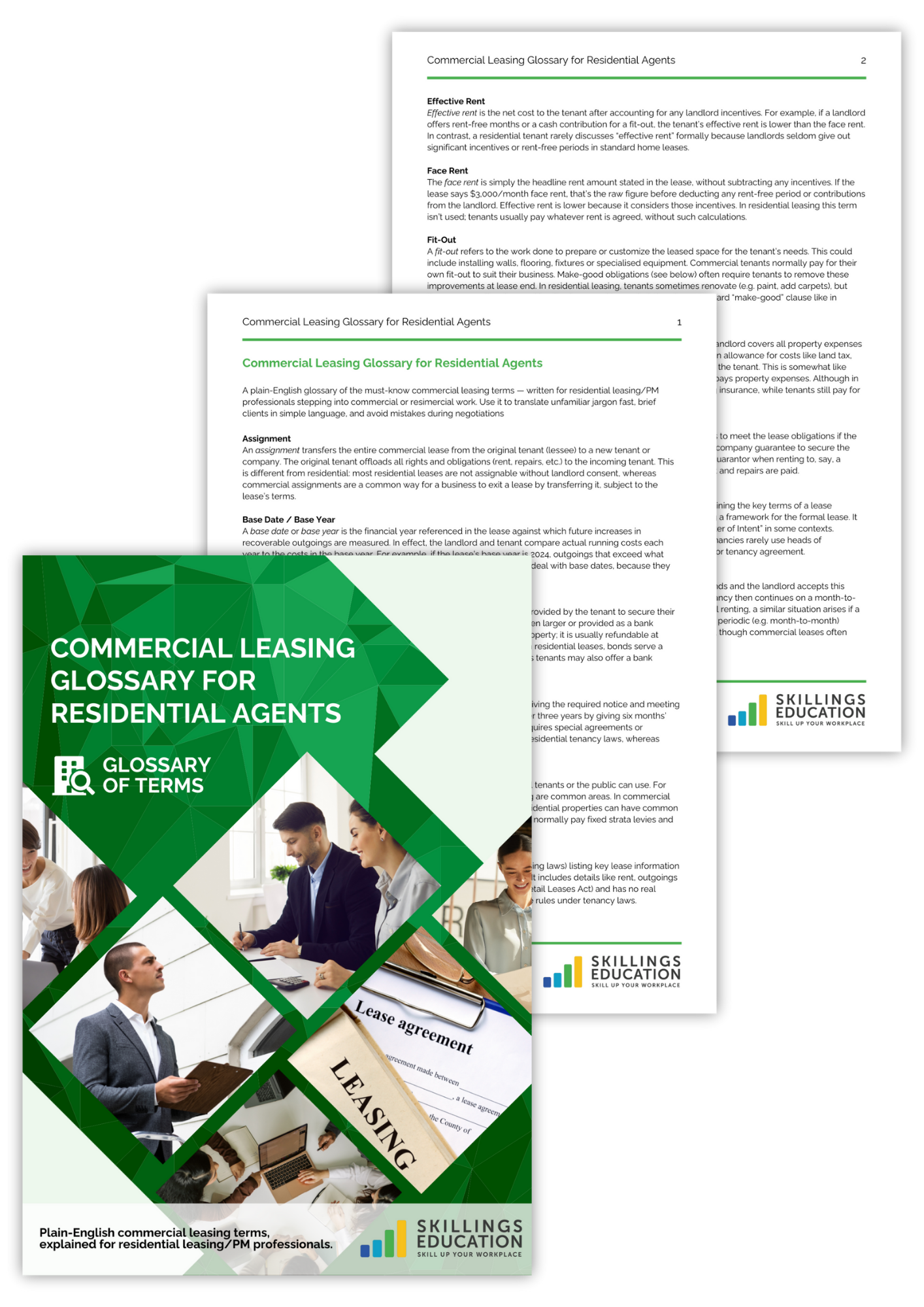
Commercial Leasing Glossary for Residential Agents

Plain-English definitions and mini-examples for rent types, incentives, reviews, outgoings, securities, and make-good.

Download the Commercial Leasing Glossary
Do I need prior asset-management experience?

Not necessarily. Many hires come from agency PM or leasing. Show you understand owner outcomes (income up, vacancy down, smart capital expenditure spend).

Will I have to take a step back in title or pay?

Sometimes. Roles like Assistant Asset Manager, In-House Leasing Coordinator, or Portfolio/Investment Analyst are common entry points. The trade-off is stable base + bonus and a higher long-term ceiling.

What should I highlight on my CV?

Outcomes, not tasks: rent uplift %, vacancy reduction, annual income added, cost savings, simple payback on upgrades, portfolio size and asset types.

Which skills should I build first?

Budgeting & variance, simple underwriting (rent roll → income; capex → payback/ROI), renewal strategy, and stakeholder communication with owners, lenders and lawyers.

Do I need advanced modelling or an MBA?

Helpful, not mandatory. Comfortable Excel and clear business cases beat complex models for most junior client-side roles. Advanced study can come later.

What’s the day-to-day like vs agency PM?

Less reactive work orders; more planning, analysis and meetings. Workload increases around budgets, reforecasts and major lease decisions.

Where do these jobs sit?

REITs and fund managers, private landlords, developers, major corporates with large footprints, and government property units.

Do I need a new licence?

Requirements vary by state/territory and employer. Check your local regulator (e.g., Fair Trading/Consumer Affairs) and the job ad.

How can I get “client-side” experience now?

Volunteer for renewal plans, write a capex mini-business case, contribute to a quarterly portfolio report—then bring those as short case studies to interviews.

What software should I know?

Excel is essential. Familiarity with portfolio systems (e.g., MRI/Yardi) and BI/reporting tools helps but can be learned on the job.

How can SKILLINGS Education help?

Courses at SKILLINGS Education are built for Australian professionals and focus on job-ready skills: owner metrics, budgeting/variance, renewal strategy, capex planning, risk/insurance basics, and stakeholder communication—plus templates, checklists and a certificate you can add to your CV.

Do I need prior commercial experience?

No. Residential leasing gives you a strong base. Many candidates start with a small commercial brief or a support role (Leasing Assistant/Analyst, Lease Admin, Assistant PM) while they upskill.

Will I earn more?

Often, yes—commercial leases are larger and multi-year. The ranges in the diagram show typical AU salaries by role; many see a 20–40% uplift once established. Expect a ramp period and fewer (but bigger) deals.

Will I still work weekends?

Mostly no. Commercial inspections, negotiations, and sign-offs are usually Monday–Friday with business clients.

How long does a commercial lease take to close?

Typically weeks to months. Expect a staged process (brief/proposal → Heads of Agreement → Agreement for Lease → Lease) with more stakeholders (solicitors, PMs, contractors).

What skills matter most to hiring managers?

Understanding how lease terms drive cash flow (incentives, rent reviews, outgoings, securities, make-good), clear communication, and clean document handling. Basic Excel (calculating net effective rent) is a plus.

What should I highlight on my CV?

Results, not tasks. Example: “Renewals +5% vs prior, vacancy down 3 pts, +$120k annual rent.” Include building types, portfolio size, and any work on term sheets/renewals.

Do I need to sign NDAs?

Often. Commercial leasing involves confidential terms (rents, incentives, outgoings). Share details only with qualified parties.

What are common entry points if I switch fully to commercial?

Leasing Assistant/Coordinator or Analyst, Lease Administrator, Assistant Property Manager (leasing focus). These roles build your commercial toolkit quickly.

Can I keep my residential pipeline while I learn?

Yes. A resimercial (hybrid) approach—maintaining residential while taking on small commercial suites/strata industrial—reduces income risk and builds case studies.

How “financial” do I need to be?

You don’t need investment-bank modeling. You do need to price to market, compare gross vs net rents, and compute net effective rent. You’ll also work with rent reviews (CPI/fixed/market) and understand outgoings and securities.

Do I need a different licence?

Requirements vary by state/territory. Check your local regulator (e.g., Fair Trading/Consumer Affairs) for the exact licence or registration needed.

How can I get experience fast?

Shadow a live lease, help with tours/admin, sit in on leasing discussions, or assist a local developer/landlord on a small brief. Turn each into a short, outcome-based case study for interviews.

What are the key KPIs in commercial leasing?

Occupancy/downtime, renewal spreads, net effective rent, quality of incentives, and tenant retention.

Start here: PROP05 — Client-Side Fundamentals & Asset Management

Who’s Involved: Deal Team & Workflow Map (AU)

See who you’ll work with—agency, owner-side, and specialists—and when they appear from enquiry to signed lease.

Commercial Leasing Glossary for Residential Agents

Plain-English definitions and mini-examples for rent types, incentives, reviews, outgoings, securities, and make-good.

Download the Commercial Leasing Glossary
More Control
Collections
Bundles
'Built With You' - Curated Learning Path
At SKILLINGS Education, you learn on demand, in focused tracks. Collections build a single skill set, Bundles combine multiple collections to solve broader, real-world problems (perfect for a resimercial rollout). We recommend:

Leasing & Tenant Advisory

Navigate every phase of the deal—strategy, search, execution, and exit—with data-driven confidence.
26 courses | 20-40 min modules

Curriculum Focus: Investment analysis, property valuation, leasing negotiations, portfolio management, due diligence

Target Roles: Asset managers, development analysts, transaction advisors, tenant reps

Industry Tools: Deal evaluation models, lease abstraction workflows, negotiation templates

Why this fits resimercial teams:
  • Learn exactly what commercial leasing needs (terms, docs, numbers) — then apply it the same week.
  • One subscription unlocks a full library for the topic you choose.
  • Verifiable certificates for credibility with landlords and business clients.

How It Works

Step 1. Choose Your Collection Plan
  • Individual Collections: Deep dive into a focused theme (e.g., Leasing & Tenant Advisory).
  • Bundles: Multiple collections packaged for outcomes (great for agencies building a commercial offer).
Step 2. Choose Your Access Plan
  • Individual Plan (1 seat): For solo upskilling — full access to the chosen collection/bundle.
  • Team Access (5 seats): For small teams building capability together.
  • Corporate Access (10+ seats): For larger agencies or multi-office groups.
Step 3. Choose Your Access Duration
  • Monthly: Quick start for targeted upskilling.
  • Quarterly: More time, multiple pathways.
  • Annual: Best value for sustained growth.
One subscription, full access. Progress tracking and certificates included on every plan.

Transparent Pricing (Individual Collections)

  • Individual (1 seat): $99 / month
  • Team (5 seats): $419 / month
  • Corporate (10+ seats): Contact us
    All prices in AUD, incl. GST.

Built For / With / By You — Training for Organisations

Whether you’re upskilling one office or rolling out across regions, choose the model that matches your capacity.
Built For You — bespoke programs (end-to-end)
We design and deliver custom courses aligned to your processes and systems.
Best for: Large teams with unique or regulated requirements.
Price:
Enquire
Built With You — curated learning paths (co-designed)
We co-create branded pathways from our 500+ course library to match job roles and goals.
Best for: L&D teams who want tailored programs without building from scratch.
Price:
AUD $280 per curated learning path
Built By You — self-serve library access
Browse, select, and assign short courses, applied mini courses, and learning paths.
Best for: Fast rollouts or ad-hoc training needs.
Price:
AUD $9.99 per course

Quick Next Steps For Resimercial Teams

  • Start with the Leasing & Tenant Advisory Collection (monthly access).
  • Add a Bundle when you’re ready to include renewals, lease admin, and PM hand-offs.
  • Co-design a curated learning path (Built With You) for multi-office rollout.
A focused, landlord-side program that helps you think and operate like an owner.
You’ll learn to:
  • Apply best-practice standards across the commercial property lifecycle: stakeholder engagement, tenant retention, capital upgrades, risk/insurance, and leasing strategy.
  • Build renewal and market-differentiation plans that lift occupancy and value.
  • Lead through issues and emergencies with clear frameworks and communication.
What's inside (5 short courses):
  • Tenant Retention & Relationships
  • Capital Improvements & Property Upgrades
  • Risk Management & Insurance
  • Market Differentiation & Leasing Strategy
  • Crisis Response & Emergency Planning
Format & support:
  • 4 weeks, ~30 mins/week, self-paced
  • Participant Guide + Course Resource Workbook + videos & quizzes
  • Dedicated support via email, live chat, or phone—evenings & weekends available
  • Certificate of Completion to add to your résumé/LinkedIn
Price: AUD $280
(4-week access)
A practical, Australian-context program that walks you through the full leasing lifecycle—exactly what residential professionals need to bridge into CRE.
You’ll learn to:
  • Understand roles & responsibilities across a commercial lease (landlord/tenant reps, internal PM) and how they collaborate for outcomes.
  • Set up agency agreements, market a property, and negotiate/review HoA clauses with confidence.
  • Navigate due diligence and legal requirements to minimise risk.
  • Communicate credibly with stakeholders using industry terminology (REI forms vs solicitor documents, etc.).
What's inside (selected modules):
Foundations
Stakeholders & consultants; agency agreements & fees; building grades; planned inspections; probing questions; lease structures; HoA fundamentals; the A-Z of commercial terminology.
Leasing terms
Rent reviews & adjustments; incentives & contributions (with case studies on rent-free, abatements, and fit-out contributions); tenant securities (bank guarantees, bonds).
Execution
Make-good (concepts, strategies, best practice with case studies); agreement for lease & lease documentation; REI vs solicitor-prepared docs.
Format & support:
  • Self-paced, 12 weeks (~1.5 hrs/week) with 10 modules / 40+ short courses
  • Participant Guide + Course Resource Workbook + videos & quizzes
  • Dedicated support via email, live chat, or phone—evenings & weekends available
  • Certificate of Completion on finish
  • Delivered by SKILLINGS Education—Australasia’s #1 eLearning platform for real estate (500+ courses)
Price: AUD $799.99
(12-week access)

Not sure where to start? We can help!

Book a demo or send us a message—we’ll help you get started with the right plan.